
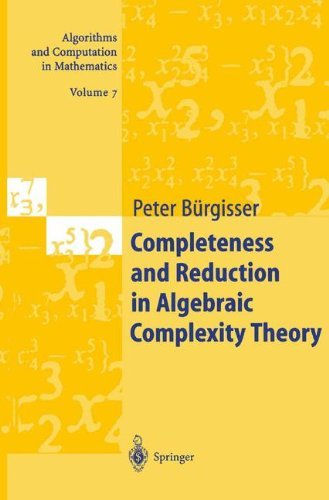
Completeness and Reduction in Algebraic Complexity Theory (Algorithms and Computation in Mathematics Book 7)
Product details
| Management number | 231815969 | Release Date | 2026/06/18 | List Price | US$23.37 | Model Number | 231815969 | ||
|---|---|---|---|---|---|---|---|---|---|
| Category | |||||||||
One of the most important and successful theories in computational complex ity is that of NP-completeness. This discrete theory is based on the Turing machine model and achieves a classification of discrete computational prob lems according to their algorithmic difficulty. Turing machines formalize al gorithms which operate on finite strings of symbols over a finite alphabet. By contrast, in algebraic models of computation, the basic computational step is an arithmetic operation (or comparison) of elements of a fixed field, for in stance of real numbers. Hereby one assumes exact arithmetic. In 1989, Blum, Shub, and Smale [12] combined existing algebraic models of computation with the concept of uniformity and developed a theory of NP-completeness over the reals (BSS-model). Their paper created a renewed interest in the field of algebraic complexity and initiated new research directions. The ultimate goal of the BSS-model (and its future extensions) is to unite classical dis crete complexity theory with numerical analysis and thus to provide a deeper foundation of scientific computation (cf. [11, 101]). Already ten years before the BSS-paper, Valiant [107, 110] had proposed an analogue of the theory of NP-completeness in an entirely algebraic frame work, in connection with his famous hardness result for the permanent [108]. While the part of his theory based on the Turing approach (#P-completeness) is now standard and well-known among the theoretical computer science com munity, his algebraic completeness result for the permanents received much less attention. Read more
| ASIN | B000PY3XVO |
|---|---|
| XRay | Not Enabled |
| ISBN13 | 978-3662041796 |
| Edition | Softcover reprint of hardcover 1st ed. 2000 |
| Language | English |
| File size | 1.9 MB |
| Page Flip | Not Enabled |
| Publisher | Springer |
| Word Wise | Not Enabled |
| Print length | 184 pages |
| Accessibility | Learn more |
| Part of series | Algorithms and Computation in Mathematics |
| Publication date | March 14, 2013 |
| Enhanced typesetting | Not Enabled |
Bestseller ranking
Algebra




Customers who viewed this product also viewed
Painting Supplies





Correction of product information
If you notice any omissions or errors in the product information on this page, please use the correction request form below.
Correction Request Form